

Premium cybersecurity visual of a calm blue network matrix where a titanium containment cube isolates malware activity while surrounding operations remain unaffected.Premium cybersecurity visual of a calm blue network matrix where a titanium containment cube isolates malware activity while surrounding operations remain unaffected.

The containment layer
that keeps control under pressure

Closing the gap between awareness and executable control

Our Containment Platform

Our platform provides a definitive operational containment layer deployed inside your network to interrupt active threat progression.

Rather than functioning as a passive monitoring tool, the S10 Group architecture delivers immediate, executable protection across three critical enterprise layers:

  • Ransomware Containment (RC): Monitors file activity to automatically stop active encryption and isolate compromised users or sessions.
  • Server Intrusion Protection (SIP): Detects and restricts unauthorised administrative access to protected servers to prevent backup deletion, restrict lateral movement, and halt data exfiltration before a wider deployment occurs.
  • Virtual Server Protection (VSP): Safeguards hypervisor environments (including VMware, ESXi, and Hyper-V) against privileged host-level exploits.

Explore our full technical capabilities and implementation frameworks →


Prevention remains essential, but no security budget can guarantee that every threat is stopped before entry.

When valid credentials are compromised or trusted sessions become unsafe, your organisation needs a containment layer that can act while the incident is still moving.

The S10 Group’s platform helps isolate malicious behaviour, stop spread, and preserve operational control before one compromise becomes a wider business disruption.


On this page

Containing the active phase of an intrusion

Ransomware often develops through access, reconnaissance, privilege abuse, data discovery and preparation before widespread encryption becomes visible. Existing prevention and detection tools remain essential throughout that sequence. The unresolved question is whether your teams can interrupt harmful activity quickly enough to limit what happens next.

Ransomware Containment is our central platform. It monitors supported file activity and isolates the affected user or session when active encryption behaviour is detected. Server Intrusion Protection and Virtual Server Protection are additional features that extend protection to compromised administrative access and supported virtual infrastructure.
Limit spread
Protect critical systems
Preserve room to operate
Reduce spread
Interrupt active encryption and restrict harmful paths before more users, file shares, servers or virtual workloads are affected.
Protect data
Reduce the incident's reach into the infrastructure that supports essential services and recovery.
Preserve operations
Keep more services available while investigation, continuity and recovery decisions continue.

Protect your critical infrastructure

Most organisations already have prevention, monitoring, and recovery tooling. The remaining gap appears when malicious activity is already inside the network and your organisation still needs a safe way to interrupt spread, protect critical infrastructure, and preserve room to operate. Our platform is designed for that moment.

What our platform changes operationally

A smaller affected field

Earlier isolation can prevent one compromised user or session from extending encryption across additional supported resources.
Compact light blue arrown pointing rightCompact light blue arrown pointing down

Better protection for critical infrastructure

Server and virtual-infrastructure protections can reduce the paths attackers use to reach high-consequence systems.
Compact light blue arrown pointing rightCompact light blue arrown pointing down

More operating options

A narrower incident gives your technical and executive teams more choice over what remains available, what must be restricted and what can return next.
Compact light blue arrown pointing rightCompact light blue arrown pointing down

A safer recovery path

Fewer affected systems reduce the number of rebuild, validation and reconnection decisions required during recovery.
Our platform is designed to limit what a security incident can reach
before encryption or infrastructure compromise creates a wider shutdown.

The investment gap between prevention and recovery

Most cyber budgets support two essential outcomes: reducing the likelihood of a successful intrusion and restoring systems if prevention fails. The most consequential phase of an incident often sits between them. Malicious activity is already present, but its reach, data access and operational impact can still be reduced.

During that interval, compromised identities, server access, file shares, supplier connections and virtual infrastructure may still be used to widen the incident while your teams are establishing what happened. Every additional system reached, dataset exposed and service disrupted expands the forensic, legal, operational and recovery burden.

Without a funded capability to interrupt that progression, your organisation moves directly from prevention failure towards a larger recovery project. Containment closes the execution gap by providing defined actions that isolate malicious activity, restrict unsafe access and interrupt progression before an initial compromise spreads into a significant security breach.

Our platform complements the controls you already use. It is not another monitoring tool and does not replace prevention, detection or recovery. It gives your teams an executable control layer for the phase in which the incident is active but the extent of its consequences can still be limited.

Head and target icon representing awareness of active risk and the routes malicious activity may still use.

Awareness

Identify active risk and the routes it may still use.
Compact light blue arrown pointing rightCompact light blue arrown pointing down
Gauge and pulse-line icon representing the execution gap where malicious activity can still widen an incident before containment takes effect.

Execution gap

The period in which malicious activity can still widen the incident.
Compact light blue arrown pointing rightCompact light blue arrown pointing down
Shield icon with connected control nodes, representing executable containment that can restrict unsafe access and interrupt malicious activity.

Executable containment

Restrict unsafe access, isolate malicious activity and interrupt progression.
The missing capability is not another description of the incident.
It is an action that limits what the incident can reach next.

Containment is not just another security investment

Additional security spending is difficult to justify when substantial budgets already support prevention, detection, backup and recovery. The case for containment is different. Its value is not measured by another stream of alerts or by a promise that every intrusion will be stopped. It is measured by the impact your organisation can avoid after something gets through.

Fewer systems affected, less data exposed, shorter disruption and a narrower environment to investigate, rebuild and validate all reduce the cost of failure. Containment can also preserve operating capacity while unsafe identities, sessions or infrastructure are isolated, reducing the pressure to choose between leaving a suspect route open and shutting down more than the incident requires.

The return on containment should therefore be assessed against plausible incident scenarios, not a generic percentage. Compare the annual cost of maintaining an executable containment capability with the reduction in exposure it can create: how much of the environment remains unaffected, which essential services can continue, how much data stays out of reach and how much forensic and recovery work can be avoided.

That changes the investment question. The issue is no longer whether your security stack needs another tool. It is whether your organisation has funded the capability that limits the operational and financial consequences when prevention is no longer the deciding control.

Why speed and scope belong in the ROI calculation

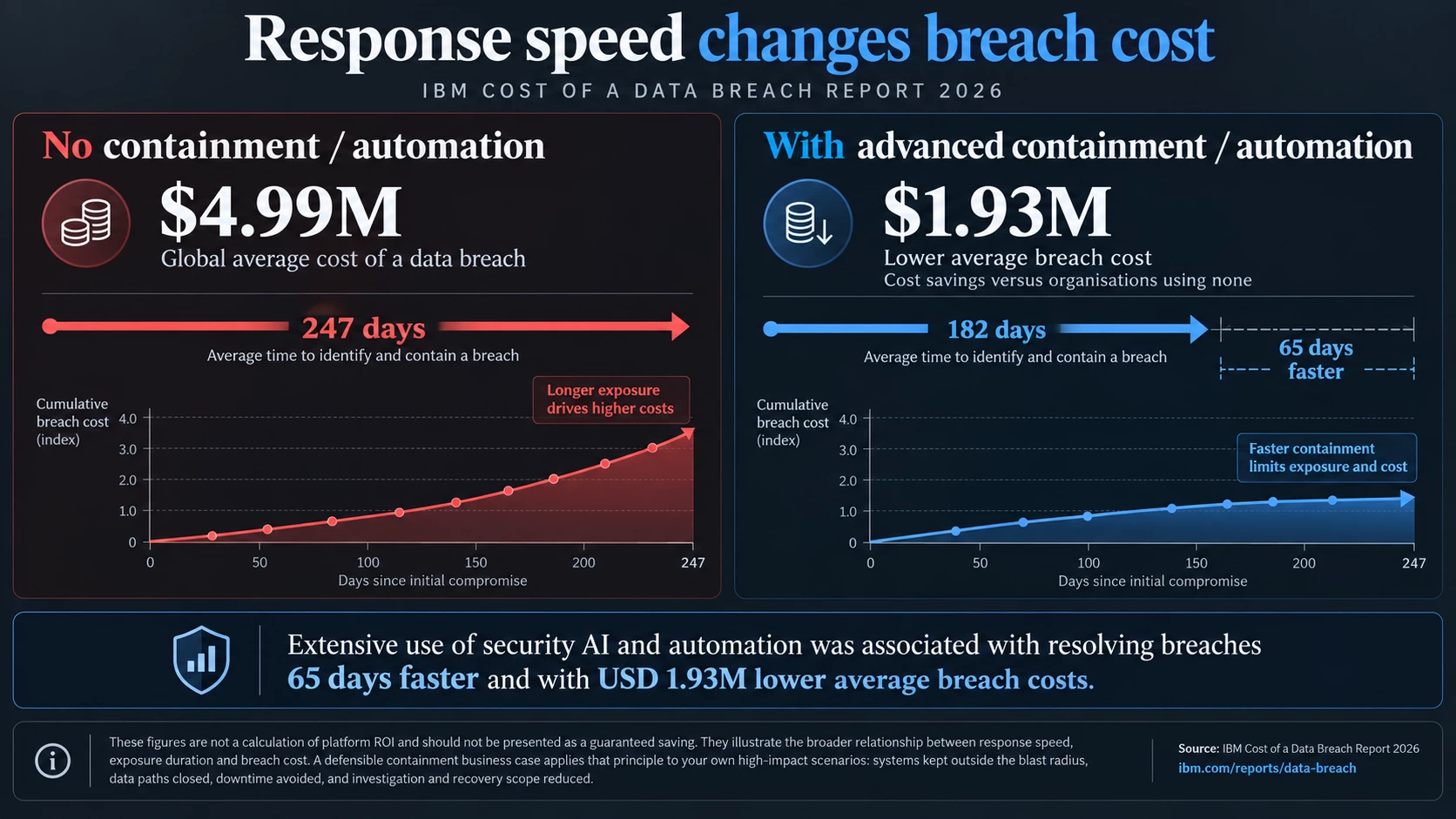
IBM's Cost of a Data Breach Report 2026 places the global average cost of a data breach at USD 4.99 million. IBM also reports that breaches took an average of 247 days to identify and contain. Organisations making extensive use of security AI and automation resolved breaches 65 days faster and incurred USD 1.93 million less in average breach costs than organisations using none.

These figures are not a calculation of our platform's ROI and should not be presented as a guaranteed saving. They demonstrate the broader financial relationship between response speed, exposure duration and breach cost. A defensible containment business case applies that principle to your own high-impact scenarios: systems kept outside the blast radius, data paths closed, downtime avoided, and investigation and recovery scope reduced.

Source:
https://www.ibm.com/reports/data-breach
View more details chevron A white downward-facing V-shaped chevron on a transparent background.
View more details
Close more details
Breach cost infographic comparing 247 days without containment to 182 days with advanced containment, linked to lower average breach cost.

When ransomware recovery becomes a weeks-long project

Ransomware recovery is rarely the restoration of one server. Your teams may need to rebuild affected systems, validate identities and backups, reconnect services in a controlled order and confirm that normal access will not reopen the incident. Operations can remain restricted throughout that work even when usable backups exist.

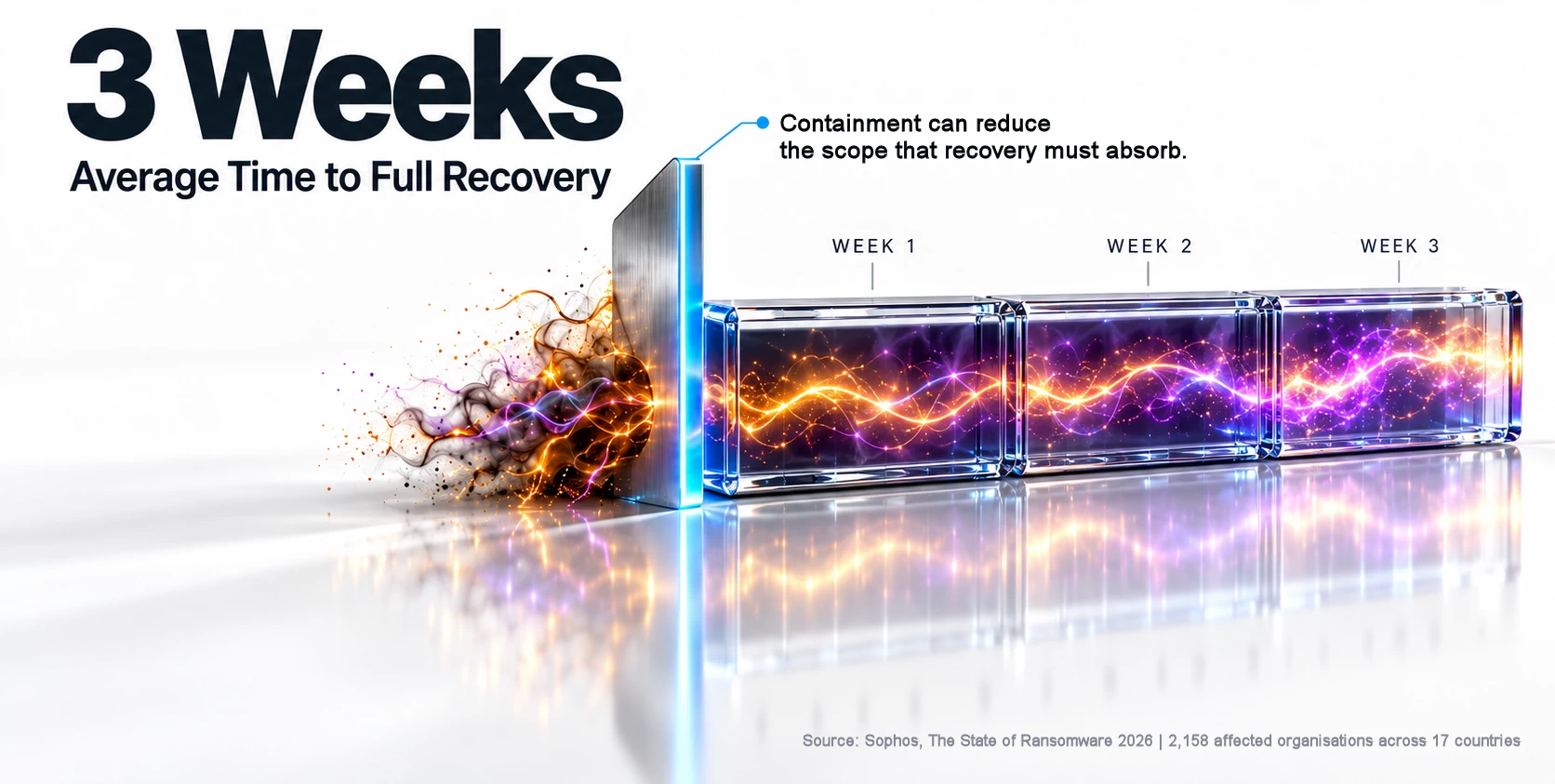
Coveware reported an average of 24 days of downtime across the ransomware cases it handled in Q2 2022. Sophos provides a more current recovery benchmark. Its 2026 survey of 2,158 affected organisations found that full recovery took an average of three weeks; 17 per cent needed longer than a month, and mean recovery cost excluding ransom payments was USD 1.70 million.

Downtime and full recovery are different measures, and neither figure predicts the outcome of a particular incident. Together, they show why the investment case should begin before recovery. Our platform is designed to interrupt active encryption and isolate the affected user or session across supported file paths. Limiting how far encryption spreads can reduce the systems, data paths and dependencies that must later be investigated, validated and restored.

Backups help your organisation return. Containment helps reduce how much of your organisation has to be brought back.
Infographic showing a three-week ransomware recovery timeline, where a blue containment barrier reduces the scope of disruption entering a three-block recovery sequence.

One platform with two additional protection features

Ransomware Containment

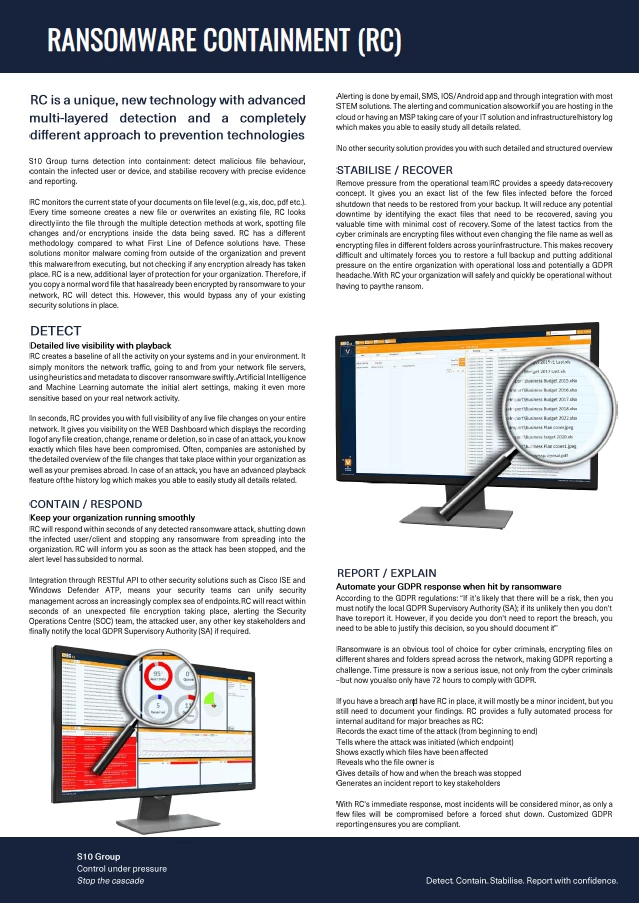
Monitors active encryption behaviour across supported SMB and NFS file paths and isolates the affected user or session to help prevent wider encryption.
Ransomware containment image of the first page of the flyer
Solution Flyer (PDF)

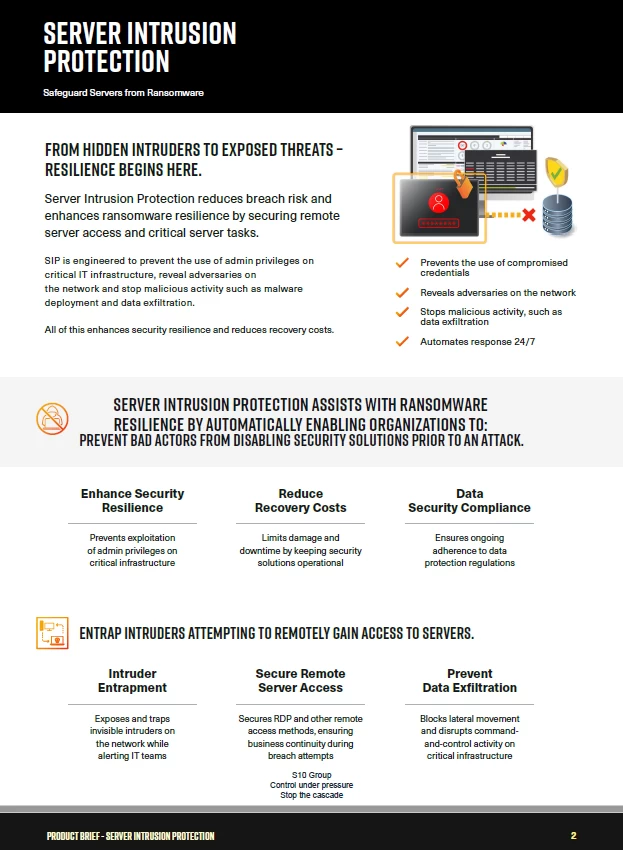
Server Intrusion Protection

An additional feature on the platform that detects and restricts unauthorised or compromised administrative access to protected servers before attackers can progress towards backup deletion or wider deployment.
Server intrusion protection image of the first page of the flyer
Solution Flyer (PDF)

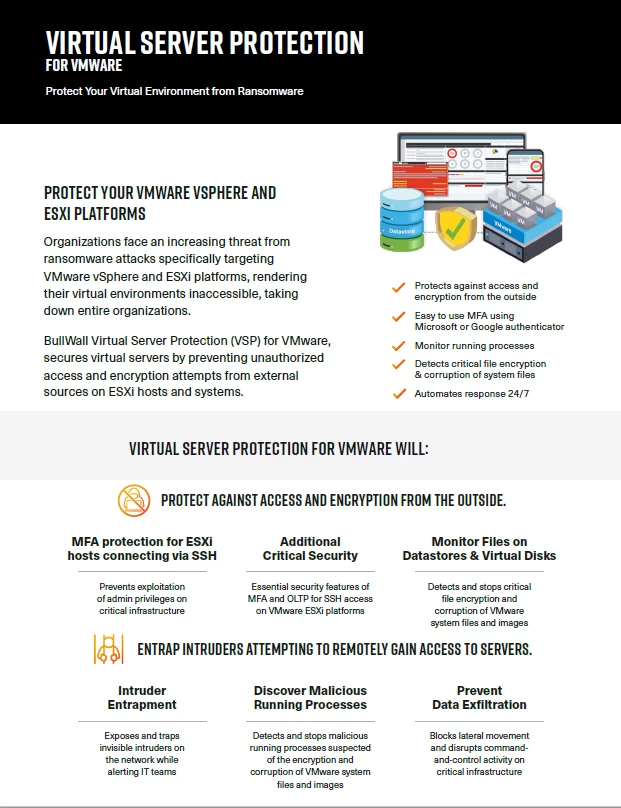
Virtual Server Protection

An additional feature on the platform that protects supported VMware, ESXi and Hyper-V environments against malicious administrative activity and host-level attack paths.
Virtual server protection image of the first page of the flyer
Solution Flyer (PDF)

A deeper look at our technical capabilities

The three capabilities address different points in an active incident. Ransomware Containment is the platform and focuses on active encryption across supported file paths. Server Intrusion Protection and Virtual Server Protection are additional features that extend the same containment approach to server administration and virtual infrastructure.

The sections below describe each capability separately so that their roles are not presented as interchangeable.

1. Ransomware Containment overview
2. Server Intrusion Protection overview
3. Virtual Server Protection overview
1. Ransomware Containment overview

Ransomware Containment is the central platform. It monitors supported SMB and NFS activity from a virtual-machine deployment and responds to active malicious encryption by isolating the affected user and session. Existing antivirus and EDR controls remain in place and continue to perform their own roles.

2. Server Intrusion Protection overview

Server Intrusion Protection is an additional feature on our platform. It focuses on administrative access to protected servers and the risk created when legitimate credentials are compromised or used outside their intended context.

3. Virtual Server Protection overview

Virtual Server Protection is an additional feature on our platform for supported VMware, ESXi and Hyper-V environments. It addresses the concentration risk created when attackers reach the administrative layer beneath many dependent workloads.

1. Ransomware Containment overview
  • Detects active malicious encryption behaviour across supported file paths.
  • Isolates the affected user or session automatically when the configured containment condition is met.
  • Stops encryption from reaching additional file shares and dependent systems.
  • Produces incident evidence and reporting that can support investigation and recovery.
2. Server Intrusion Protection overview
  • Monitors protected administrative access paths and server logon activity.
  • Detects patterns associated with compromised administrator credentials or unauthorised remote access.
  • Restricts the attacker before server-side activity can progress towards backup deletion, wider deployment or deeper infrastructure compromise.
  • Preserves access records that support investigation and audit.
3. Virtual Server Protection overview
  • Monitors supported virtual infrastructure for unauthorised administrative activity and malicious processes.
  • Helps restrict host-level actions that could affect multiple virtual machines or datastores.
  • Extends containment to an infrastructure layer that endpoint controls may not protect directly.
  • Supports automated response while virtual-environment investigation and recovery decisions continue.

1. Ransomware Containment overview

Ransomware Containment is focused on active encryption behaviour and the protection of critical data paths and infrastructure. Its role is to detect illegitimate encryption activity quickly, isolate compromised users or devices, and reduce the chance that an outbreak spreads across file shares, application servers, database servers, or other business-critical systems.

  • Detects active malicious encryption behaviour
  • Isolates compromised users or devices automatically
  • Protects critical infrastructure and data paths
  • Supports compliance-ready reporting and recovery visibility

2. Server Intrusion Protection overview

Server Intrusion Protection is focused on one of the most common and consequential early breach pathways: remote server access. Its role is to reduce the chance that compromised credentials, unauthorised RDP sessions, or malicious server-side activity can be used to progress the attack toward deployment, reconnaissance, lateral movement, or data theft.

  • Secures remote server access with additional control measures
  • Reduces risk from compromised credentials and RDP abuse
  • Helps stop breach progression earlier in the sequence
  • Creates immutable records of access activity for investigation and audit

3. Virtual Server Protection overview

Virtual Server Protection is focused on virtual infrastructure such as VMware and ESXi environments. Its role is to reduce the risk that attackers can use privileged access, malicious processes, or encryption attempts to render virtual environments inaccessible or to damage the systems that support wider business continuity.

  • Protects virtual environments from unauthorised access and encryption attempts
  • Monitors malicious process activity and system-file corruption risk
  • Helps contain threats targeting VMware and ESXi environments
  • Supports 24/7 automated response and stronger virtual-environment resilience

Together, Ransomware Containment and the two additional features limit different routes by which an active incident can reach critical systems. They are one platform architecture, not three separate platforms.

One platform, three operational protection layers.
One purpose: to stop an incident from turning into a cascading crisis.

How our platform integrates with your existing security stack

Our platform complements the prevention, endpoint, monitoring, network-access and recovery tooling that you already have in place. It does not require those controls to be removed or disabled.

A two-way REST API supports integration with SIEM, network access control, EDR and broader security workflows. Those integrations can pass relevant signals and containment actions between systems, subject to the configuration and products in your environment.

The value is practical. Existing controls continue to provide prevention, detection and evidence, while our platform adds a containment action for active encryption, compromised server administration and supported virtual infrastructure.

How our platform fits into your existing stack represented by an example of four white brand logos in sequence Crowdstrike, Darktrace, SentinelOne and Cisco displayed at a blue background
Your current stack remains the source of visibility.
Our platform adds a way to act on defined malicious behaviour before the incident reaches more critical systems

What our platform does not replace

What our platform adds

  • Prevention and detection
    Your firewall, identity controls, EDR, SIEM and monitoring environment remain essential.
  • Incident governance
    Our platform does not assign decision authority, determine legal obligations or make continuity choices for your executive team.
  • Recovery
    Containment can reduce the recovery field, but investigation, validation and restoration are still required.

What our platform IS

  • Ransomware Containment
    The central platform adds automated isolation when active malicious encryption is detected across supported file paths.
  • Protection for server administration
    Server Intrusion Protection extends the platform to compromised or unauthorised administrative access on protected servers.
  • Protection for virtual infrastructure
    Virtual Server Protection extends the platform to supported hypervisor and host-level attack paths.

How protection is applied across the environment

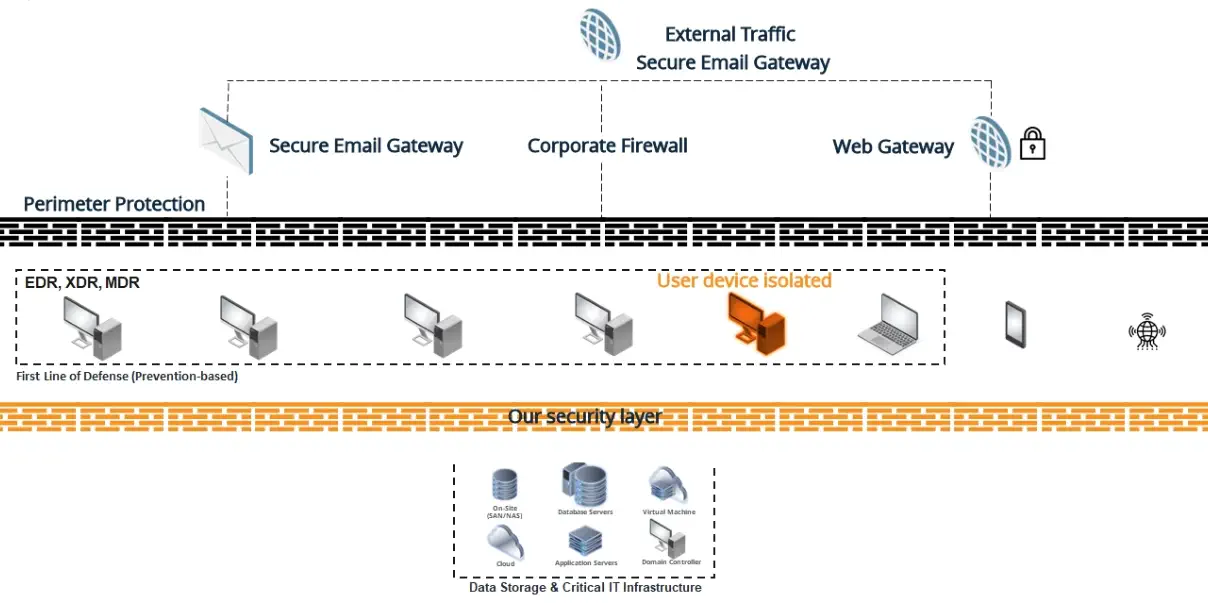
The architecture diagram shows where our platform adds protection alongside perimeter defences and endpoint controls. It should be read as a functional model, not as one literal network layer placed beneath every existing security product.

External traffic versus S10 group security layer represented by a technical network architecture diagram demonstrating infrastructure defence layers. The top section shows external traffic passing through a Secure Email Gateway, Corporate Firewall, and Web Gateway, sitting above a black 'Perimeter Protection' boundary line. Below the perimeter is the 'First Line of Defence (Prevention-based)' containing endpoints like EDR, XDR, and MDR, where one workstation is highlighted in orange as a 'User device isolated'. Directly beneath this endpoint layer is a solid orange brick wall labelled 'Our security layer', acts as a containment barrier that completely separates the isolated compromise from the 'Data Storage & Critical IT Infrastructure' at the bottom, which includes SAN/NAS, database servers, virtual machines, cloud, application servers, and the domain controller.

Ransomware Containment can be deployed on a physical or virtual Windows Server and monitors supported SMB and NFS file activity across the protected environment. When active malicious encryption is detected, it isolates the affected user or session. Server Intrusion Protection adds controls around protected server administration. Virtual Server Protection extends protection to supported VMware, ESXi and Hyper-V infrastructure.

Each capability restricts a different route by which an incident can expand. Together, they help keep more critical infrastructure outside the affected field while investigation and recovery continue.

Our platform is designed for containment, not passive observation.
It provides defined actions that interrupt malicious progression before an initial compromise spreads into a significant security breach.

See how Ransomware Containment changes active encryption

Our free remote assessment compares active file-encryption scenarios inside your own isolated test environment with your existing security controls active, first without Ransomware Containment, and then with it enabled.

The core technical vectors Server Intrusion Protection (lateral movement and data exfiltration etc.) and the Virtual Server Protection capabilities are then addressed during this collaborative review session.
Bright conceptual visual of frosted-glass blocks where the first block is stopped by a titanium pillar, representing ransomware containment before wider operational disruption spreads.